
RESOURCES
New Jersey Autism Resources
Provides information about autism, autism treatments, and a wide variety of topics related to autism and science-backed treatments and strategies. Click here
A booklet created by the Association for Science in Autism Treatment for parents/guardians of children recently diagnosed with autism. Click here
Autism New Jersey is a nonprofit agency committed to ensuring safe and fulfilling lives for individuals with autism, their families, and the professionals who support them. Through awareness, credible information, education, and public policy initiatives, Autism New Jersey leads the way to lifelong individualized services provided with skill and compassion. We recognize the autism community’s many contributions to society and work to enhance their resilience, abilities, and quality of life. Click here
Helpline service for information in New Jersey about autism, special education, early intervention services, adult services, and referrals. More information about the helpline can be found here.
A nonprofit organization that provides resources on many topics such as safety plans, training and events, blog posts, etc. for families in New Jersey. The group also runs an online parent group and helps organize autism-friendly family events and recreational activities. Click here
Created by Sesame Street to help celebrate every child. Includes videos, crafts, games, and resources for families and children. Click here
Hosts workshops, research opportunities, and has information about the latest research in the field of autism. Click here
New Jersey Doctors For Diagnosis
As You Are is a team of physicians who specialize in guiding families along their neurodevelopmental journey.
Schedule a virtual visit with As You Are to get started!
Nemours Children’s Hospital, Delaware, and at select Nemours locations.
Mount Laurel, NJ 08054
Frequently Asked Questions: ABA Therapy
From inquiry to first session with a behavior technician, the process typically takes 4-8 weeks. Within that timeframe, we’ll guide you through the intake process and match your child with a dedicated clinical team. Learn more.
Applied behavior analysis (ABA) is a science-based approach that helps people understand and change behavior in ways that are meaningful and valuable for the person involved. In the field of ABA, scientific principles that explain how learning occurs guide the development of strategies, interventions, and procedures that are used in ABA therapy sessions.
Applied behavior analysis, or ABA therapy, focuses on how our knowledge of learning and behavior is applied in a therapeutic approach to better understand and change behavior to improve a person’s life and wellbeing.
The goal of ABA therapy is to help people make meaningful and lasting changes in their lives. Because ABA focuses on creating positive change for each person, ABA therapy must be individualized to reflect the unique interests, goals, and characteristics of each child. Learn more about ABA Therapy at Gentle Care here.
For ABA services to be covered by your insurance in New Jersey, your child will need a diagnosis of autism from a qualified health professional. We will need a copy of the comprehensive evaluation and a script referring your child for ABA services. You can view the full list of insurances we accept here.
GentleCare Therapy accepts most major New Jersey health insurance plans. We have dedicated care coordinators to help you navigate your coverage and get the therapy you need. You can view the full list of insurances we accept here.
Every ABA therapy session is different! Since every child has unique interests and needs, there is not a standardized plan or structure for ABA therapy. Instead, each child will work towards their individual goals with the support of an ABA therapist.
ABA therapy sessions are carefully designed to be fun and engaging for the child while also incorporating effective, evidence-based strategies that will help the child learn new skills in a supportive and caring environment. Your child’s ABA therapist will track how your child is progressing towards their goals by collecting data during each therapy session.
During ABA therapy sessions, teaching can happen during more structured, therapist-led activities (often referred to as DTT, or discrete trial teaching) and during less structured, child-led activities. The combination of teaching approaches, procedures, and tools that are used in an ABA therapy session will be identified based on each child’s needs.
ABA therapy is often recommended as an autism therapy option because it is “evidence-based.” This means that, through extensive scientific research over the last several decades, ABA-based strategies have resulted in improved outcomes for people with autism. Because of the large amount of research supporting ABA as a therapeutic approach to autism, ABA therapy is often covered by health insurance companies and recommended by medical providers who diagnose autism.
ABA therapy is also recommended as an autism treatment option because of the individualized approach that is used. Every child with autism will have different strengths and goals and ABA therapy can be tailored to focus on the unique strengths and goals of each child.
The number of hours of ABA therapy that a child receives each week - and for how long a child continues participation in an ABA therapy program - should be based on the individual needs of the child.
When beginning the process of finding an ABA therapy provider, families should keep in mind that the number of ABA therapy hours their child receives should not be based solely on their age or their history of receiving ABA services in the past. Instead, a board certified behavior analyst (BCBA) should complete a comprehensive assessment for your child to better understand their current skills, skill development needs, and behavioral challenges. After the BCBA completes this initial assessment for your child, they should then provide your family with a personalized ABA treatment plan, including recommendations for the number of hours of direct, 1:1 ABA therapy that your child would benefit from receiving.
Typically, behaviors addressed during ABA therapy sessions fall into two broad categories - behaviors to develop, increase, or sustain and behaviors to decrease.
ABA therapy can help teach many different types of new skills, such as self-care skills, communication, social interaction skills, academic readiness skills, job-related skills, and instruction following skills.
ABA therapy can also help to reduce behaviors that may be dangerous or harmful, prevent a child from engaging in their preferred activities or daily routines, or otherwise cause discomfort or distress to the child. Some examples of behaviors that might be targeted for reduction in an ABA therapy program include aggression, self-injurious behavior, and tantrums.
A parent/guardian’s active participation in an ABA therapy program is essential for a child to achieve the best possible outcomes.
Parents/guardians will be involved in a child’s ABA therapy program in many different ways. They will provide valuable information to the ABA therapy team about their child’s strengths, challenges, preferences, and dislikes and about spiritual or cultural values, beliefs, and practices of the family that can be incorporated into the child’s ABA therapy plan.
Parents/guardians might also be asked to observe ABA therapy sessions, participate in assessments that are completed for their child, and attend training sessions to learn about concepts and strategies in ABA and to practice using those strategies, with the guidance of their child’s BCBA, while interacting with their child. Parents/guardians can expect to have several parent/family training goals that they will work towards while their child is enrolled in an ABA therapy program.
We provide EI services throughout the Philadelphia area. We don't provide EI services in NJ. To learn more about our EI services in the Philadelphia area, click here.
Frequently Asked Questions: Speech Therapy
Speech therapists work with: articulation (speech sounds, intelligibility), language (expressive, receptive), augmentative and alternative communication (communication devices), pragmatics (social language), stuttering/fluency, and feeding (oral-motor, swallowing, sensory, picky eating).
School-based speech therapy is provided within the school setting, typically by a speech-language pathologist employed by the school district. The primary focus is on helping students improve their communication skills to succeed academically and socially within the school environment. Therapy goals are often related to the educational curriculum, addressing issues such as articulation, language development, social communication, and fluency as they impact the student's ability to learn and interact at school. Services are usually delivered in small groups or individually during school hours, with frequency and duration determined by the student's Individualized Education Plan (IEP).
Private speech therapy is offered outside of the school environment, usually in clinics or private practices. This type of therapy provides a more individualized and intensive approach, addressing a broader range of speech and language issues, including those not directly related to academic performance. Goals are tailored to the client's specific needs and may cover specialized and targeted intervention areas such as apraxia, dyslexia, voice disorders, and feeding/swallowing disorders. Sessions are typically provided one-on-one and flexible, based on the client's progress and needs. More frequent assessments can be conducted to track progress and adjust therapy plans. Private speech therapy is often funded by the client's family or through insurance, offering personalized and comprehensive intervention.
Speech refers to the physical production of sounds and words, encompassing articulation (how speech sounds are made using the tongue, lips, jaw, and mouth) and/or coordination, voice (use of vocal cords and breathing to produce sound), and fluency (rhythm and flow of speech).
Language includes vocabulary, grammar, and the ability to understand and produce sentences. Language can be divided into receptive language (understanding what others say) and expressive language (using words and sentences to communicate thoughts). It can also include social communication and pragmatic language skills.
While speech focuses on the mechanics of producing sounds, language encompasses the ability to understand and express language.
During the evaluation, the assessment may include a medical records review, parent report, standardized test, observation through play, and dynamic assessment. Following the evaluation, it will be determined if treatment is necessary. You will receive a copy of your child’s evaluation within 7 days of the evaluation.
Speech therapy sessions (both evaluations and sessions) occur in our clinic in Gibbsboro, NJ.
Your speech pathologist will provide recommendations for therapy frequency following the initial speech evaluation. Therapy appointments typically occur in recurring timeslots 1-2 times per week for 30 minutes. There may be additional and more intensive services recommended. Frequency is determined by numerous facts, such as the type of disorder, current skill set, severity of disorder, age, and comorbidities.
There is no one-size-fits-all or quick fix to therapy. Each child develops and progresses at different rates. It may take several months, or years, to see progress. With consistency, progress and meeting goals is possible. Parental involvement, such as practicing at home, can accelerate progress. It is important to note that progress may be impacted by a child's motivation, incorrect practice or unrealistic expectations and/or demands placed on the child.
For young children, unfamiliar listeners should be able to understand 25% of speech by age 1, 50% of speech by age 2, 75% of speech by age 3 and 100% by age 4.
Caregivers are an integral component of the team. Caregivers are invited in the treatment room in the administrative wing to observe therapy and/or participate when deemed appropriate. Home programs may be provided to increase carryover in all settings. If caregivers are not physically present during the session, they can request completion of a speech therapy session note for details regarding the session.
One hour for initial evaluations and 30 minutes for therapy sessions.
No.
Speech services will begin a minimum of 14 days after the initial evaluation, pending insurance approval.
Social Stories and Materials
A Visit to the Doctor
The social story “A Visit to the Doctor” was designed by our clinical team to help parents prepare their child for a doctor’s appointment.
Powered By EmbedPress
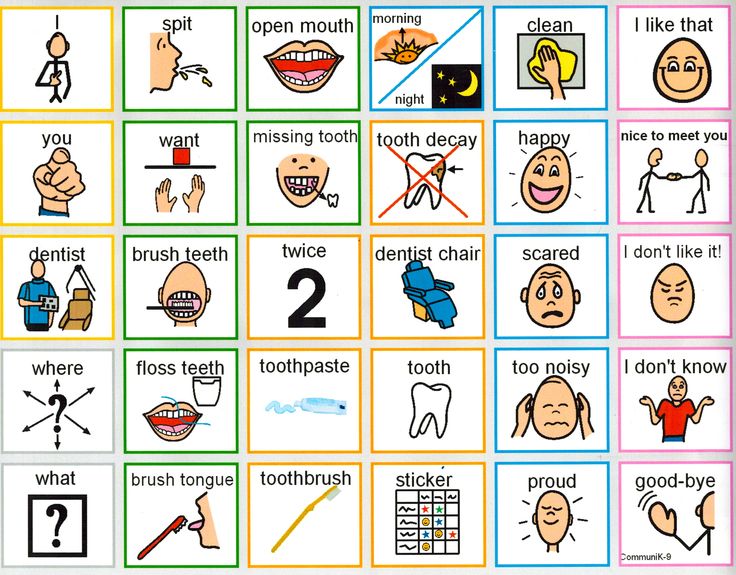
DENTAL VISIT CORE BOARD
Going to the dentist can be scary but with the help of a communication core board, expressing emotions and feelings or communicating needs might make the visit a little easier.
Core boards combine pictures and words of core vocabulary to support communication by pointing at the prompts and photos.
Feel free to download this board!

"A Visit to the Dentist"
Social Story

The social story below titled “Going to the Dentist” was designed to help parents prepare their child for a dentist’s appointment.
Going to the dentist can be scary for some children but having a social story as a tool on hand to explain what to expect and what will happen at the visit is a great way to relieve a little bit of the anxiety and explain to them what’s going on, what instruments the Dr. will be using and what happens when they’re all done!

Track your child's milestones!
The CDC’s Milestone Tracker app, provides a fun and easy way for parents and caregivers to track and support their child’s early development.
From birth to age 5, your child should reach milestones in how he or she plays, learns, speaks, acts, and moves. Photos and videos in this app illustrate each milestone and make tracking them for your child easy and fun!