
Key Takeaways
- Halloween offers natural chances to practice AAC and speech skills.
- Involve your child in choosing a costume and planning the trick-or-treat route with words like “first,” “next” and “last.”
- Visuals, crafts, books and role-playing help set expectations for Halloween night.
Preparing Your Child for Halloween: Enhancing AAC and Speech Skills!
Halloween is just around the corner! For many families, it’s a time filled with excitement and creativity! For children using Augmentative and Alternative Communication (AAC) systems or those working on speech skills, getting ready for Halloween can also be a fantastic opportunity for learning and development.
Below our team outlines some ways you can prepare your child for a spook-tacular holiday while boosting their communication skills.
1. Choose a Costume Together
Communication Opportunities
Involve your child in the costume selection process. Discuss different options, encouraging them to express their preferences using their AAC device or speech. Ask questions like:
– “What character do you want to be?”
– “Do you prefer something scary or something silly?”
Increase Vocabulary
Introduce new vocabulary related to costumes, such as “witch,” “pirate,” “superhero,” or “pumpkin.” This not only enriches their language but also helps them become familiar with Halloween themes.
2. Plan a Trick-or-Treat Route
Temporal Concepts: First, Next, Then, Last
Work together to plan your trick-or-treat route. You can create a visual map, marking houses you want to visit like a treasure hunt! This can be a great way to discuss concepts like “first,” “next,” “then,” “after,” and “last”.
Role-Playing
Practice phrases your child might use while trick-or-treating. Role-playing scenarios can help them feel more comfortable. Use phrases like:
– “Trick or treat!”
– “Thank you!”
– “Can I have a piece of candy?”
3. Use Halloween-Themed Visuals

Custom Communication Boards
Make a Halloween-themed communication board or display for your AAC device. Include pictures and symbols related to Halloween activities:
– Costumes
– Candy
– Decorations
– Actions like “scare,” “share,” or “play”


AAC Bracelets
While out trick or treating children can wear AAC bracelets to easily communicate their needs and preferences, ensuring they have a fun and inclusive experience while collecting treats! Follow this link to print out your own! Use tape to connect the bracelet to their wrist or costume (if they’re uncomfortable wearing it on their wrist) and have your child wear it to say prompts like:
– “Do you want a piece of candy?” 👉 🍬
– “Thank you!”
– “Trick or treat!”
 4. Create Halloween Crafts
Hands-On Crafts
Get crafty! Create decorations, cards, or treat bags together. This is a great way to incorporate language skills. As you work, describe what you’re doing and ask open-ended questions:
– “What color should we use for the ghost?”
– “How can we make our pumpkin look spooky?”
Expressing Ideas
Encourage your child to describe their creations. Prompt them to use sentences like:
– “I made a spooky ghost!”
– “This is my favorite Halloween color!”
5. Practice Social Skills
Greeting Neighbors
If possible, practice greeting neighbors and friends in costume. Role-play social scenarios to help your child feel comfortable initiating conversations and responding to others.
Using Total Communication in Social Contexts
Encourage your child to use their AAC device, signs, words or gestures to initiate conversations. Gestures:
– waving 👋
– “more”
Phrases like:
– “What are you dressed as?”
– “Do you like Halloween?”
6. Read Halloween Books
Read Together
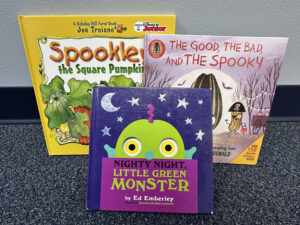
Select Halloween-themed books and read together. Some fun stories include: Go Away Big Green Monster, Little Blue Truck’s Halloween, How to Catch a Witch. Discuss the stories and characters, asking questions that promote conversation:
– “What do you think will happen next?”
– “Which character do you like the most?”
7. Set Expectations for Halloween Night
Preparation Talks
Discuss what to expect on Halloween night. Explain the process of trick-or-treating, emphasizing safety and etiquette. Use visuals or social stories to make this clearer.
Using AAC for Safety
Teach your child key phrases or use visuals in case they feel overwhelmed or need assistance. Phrases or words like:
– “I need help.”
– “I feel scared”
– “All done”
– “Can we go home?”
With a little preparation, Halloween can be a fun and educational experience for your child, especially when integrating all forms of communication into the festivities. Encourage open communication, creativity, and practice, making this holiday not just about candy, but also about connection and learning. Happy Halloween!
Related reading: Autism-Friendly Tips for Preparing Your Child for Halloween and 5 Core Vocabulary-Loaded Books to Enhance Speech and Language
How GentleCare can help: Learn more about our Speech Therapy services, or visit our Enrollment page to get started.
Supporting families in Cherry Hill, Voorhees, Camden, Mount Laurel, Gloucester, Deptford, Burlington, Marlton and throughout Burlington, Camden and Gloucester Counties. We’re currently enrolling! Contact us to learn more and to get started.