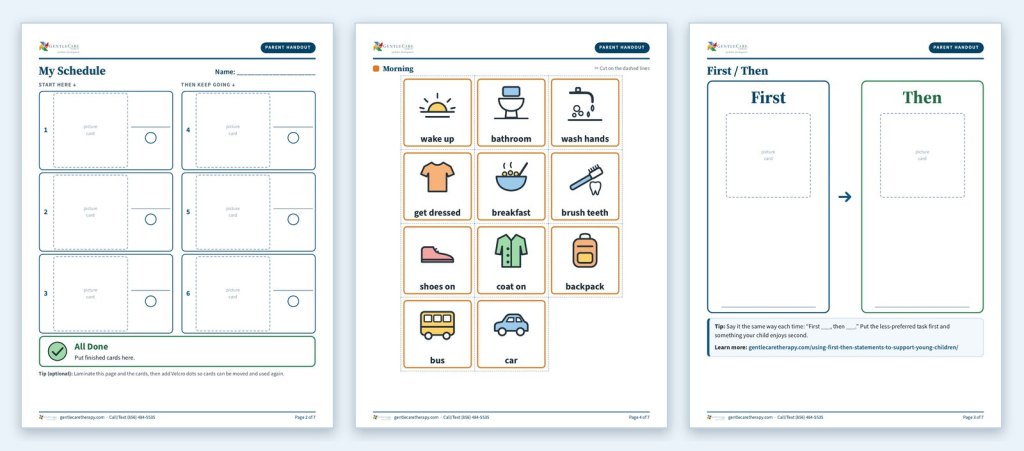
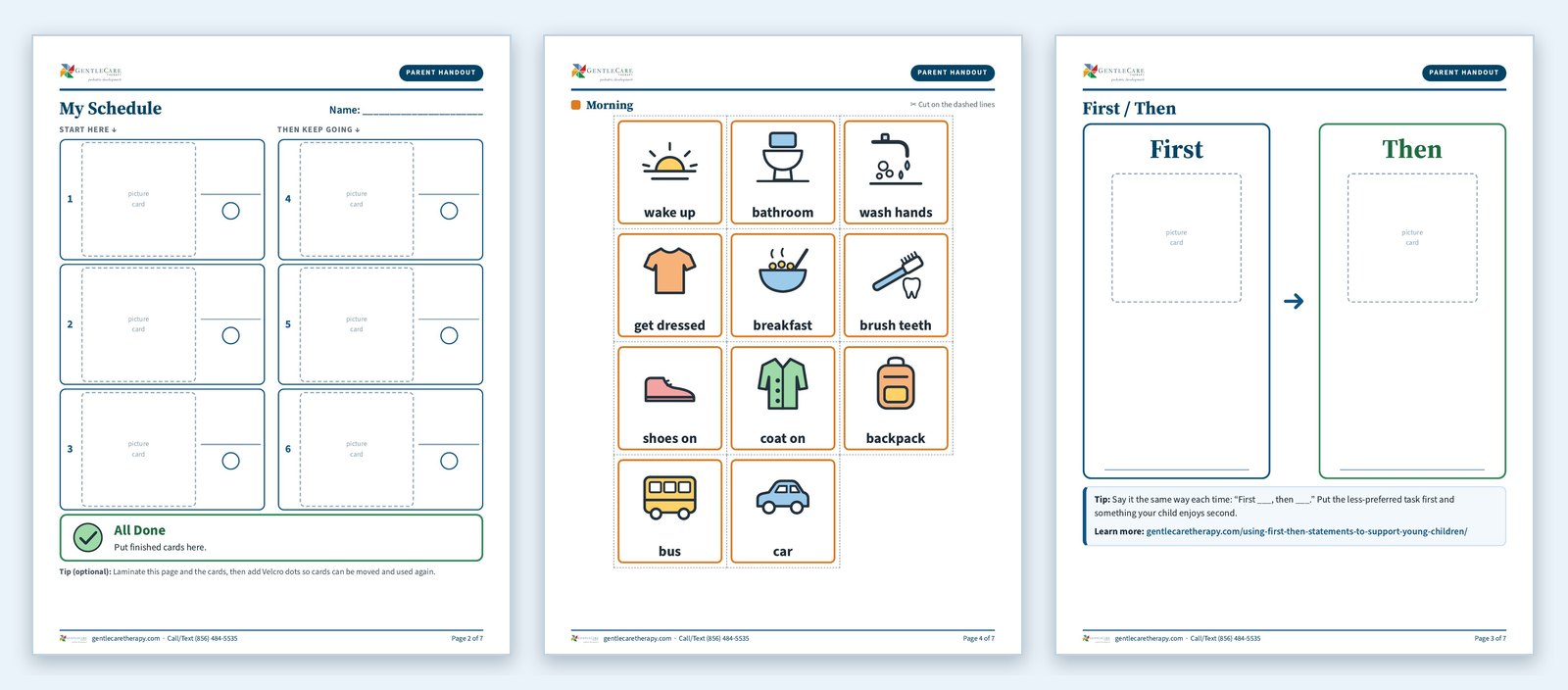
Want to change the cards? The editable Word version lets you move, swap and relabel the picture cards, then print.
Make routines predictable, one picture at a time.
A picture schedule shows your child, step by step, what will happen and in what order. This printable gives you everything you need to make one at home: a My Schedule strip, a First / Then board and picture cards for everyday routines. Below you will find how to print it, cut it out, set it up and use it. For more background, read Visual Schedules: Making Routines Predictable.
What’s in the Printable
- Page 1: How to use your visual schedule. A quick how-to and tips to keep near the schedule.
- Page 2: My Schedule strip. Six numbered spaces for picture cards, a spot for your child’s name and an All Done area for finished cards.
- Page 3: First / Then board. Two spaces, “First” and “Then,” for one picture card each.
- Pages 4–7: Picture cards to cut out. 37 picture cards for morning, school and therapy, after school and bedtime, plus helpful cards (all done, wait, break, help, change, first, then) and 4 blank cards.
Step 1: Print and Cut
- Print the PDF on regular letter-size paper. Heavier paper or cardstock holds up better if you have it.
- Cut the picture cards on the dashed lines. You don’t have to cut them all at once; start with the cards for the routine you plan to use first.
- Optional: laminate the strip, the board and the cards, then add Velcro dots so cards can be moved and used again.
Step 2: Set Up the My Schedule Strip
- Pick one routine. Start with the hardest time of day, such as mornings or bedtime.
- Choose 3–5 steps. Pick the picture cards for each step. Start small; you can always add more later.
- Put them in order. Place the cards from top to bottom on the schedule strip, starting at “Start here.”
- Show and practice. Walk through it together: “Let’s check your schedule.” Help at each step, then give less help over time.
- Mark it “all done.” When a step is finished, move its card to the All Done area.
Example morning routine: wake up, bathroom, get dressed, breakfast, brush teeth, backpack.
Step 3: Use the First / Then Board
The First / Then board is a simpler, two-step version of a schedule. It works well for one moment in the day, such as getting through a task before a favorite activity.
- Put a less-preferred task in the “First” space and something your child enjoys in the “Then” space.
- Say it the same way each time: “First ___, then ___.” For example, “First shoes on, then outside.”
- When the “First” step is done, point to the “Then” card and follow through right away.
Learn more in Using First/Then Statements to Support Young Children.
Step 4: Make Your Own Cards
The 4 blank cards let you add steps that are special to your family. Draw a simple picture or glue on a photo, then write the word underneath, such as a family member’s name, a favorite place or an activity that isn’t in the set.
The helpful cards can be used alongside any routine. For example, add a “change” card when something different is coming, or a “wait” or “break” card when your child needs one.
Tips for Success
- Keep it where your child can see it. Place the schedule in the room where the routine happens.
- Use the same simple words each time. For example, “Let’s check your schedule.”
- Praise each finished step. Celebrate effort as your child moves through the routine.
- End with something your child enjoys. A favorite book or song at the end can help with the earlier steps.
- Let your child help. Invite them to place the cards or move finished cards to All Done.
- Be flexible. Things happen. Swap cards when plans change and add a “change” card to show what is different.
Helpful links:
- Visual Schedules: Making Routines Predictable
- Using First/Then Statements to Support Young Children
- Daily Routines for Kids with Autism: A Simple Guide for Parents
Want help building routines that work for your child? Reach out to our team today.
This handout is general education and does not replace advice from your child’s care team.