Children communicate for many different reasons. We call these reasons communication functions. A child might use words, signs, gestures, or a device to ask for a snack, point out an airplane, tell you something is wrong, or share how they feel. Many children start out using mostly one function, such as requesting. They may need extra support to comment, ask questions, or share their feelings.

Why Communication Functions Matter in ABA
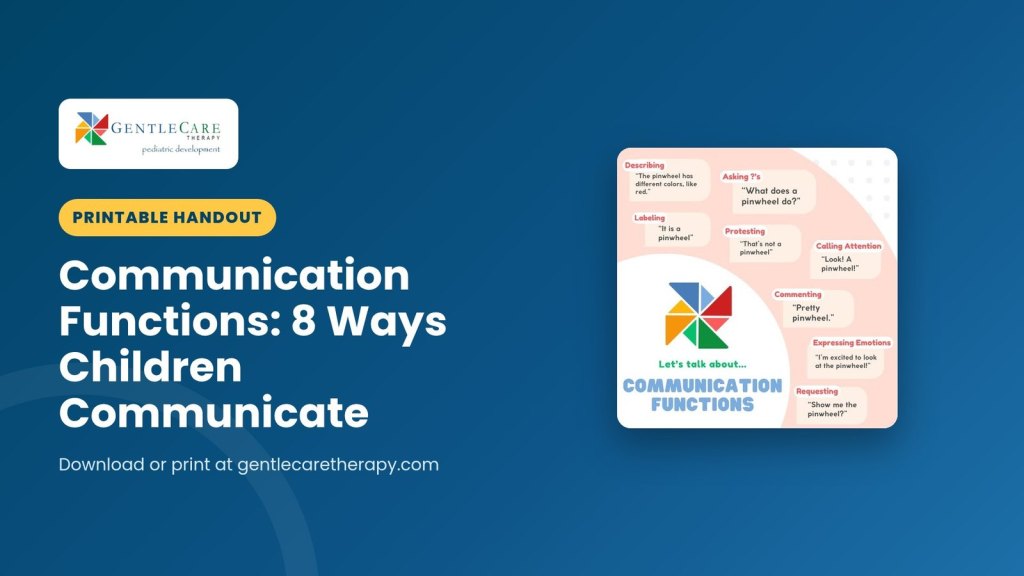
When we know which functions a child already uses, we can see which ones to build next. A child who can say “cookie” to get a cookie has a great start. Learning to say “Look, a cookie!” or “I don’t want a cookie” opens up new ways to connect with family and friends. Each function below uses the same object, a pinwheel, to show how one item can spark eight different kinds of communication.
Let’s talk about…
Describing
“The pinwheel has different colors, like red.”
Labeling
“It is a pinwheel”
Asking Questions
“What does a pinwheel do?”
Protesting
“That’s not a pinwheel”
Calling Attention
“Look! A pinwheel!”
Commenting
“Pretty pinwheel.”
Expressing Emotions
“I’m excited to look at the pinwheel!”
Requesting
“Show me the pinwheel?”
How GentleCare Applies It
Our team starts by watching how your child communicates now: which functions they use, how often, and in which settings. From there, your child’s BCBA writes goals to expand those skills, for example moving from requesting only to also commenting and asking questions. When it helps, we use augmentative and alternative communication (AAC), such as picture symbols or a speech-generating device, so your child has a reliable way to share every function. We also coach parents and caregivers so these skills carry over to home.
Try It at Home
- Pick one fun object. A pinwheel, bubbles, or a favorite toy works well. Use it to model several functions in a row: “Look! Bubbles!” “Big bubbles.” “Uh oh, all gone!”
- Pause before you help. Hold the toy and wait a few seconds so your child has a chance to request, protest, or comment.
- Accept every way of communicating. A point, a sign, a word, or a button on a device all count. Respond warmly and add a word or two.
- Wonder out loud. Ask simple questions (“What does it do?”) and answer them yourself sometimes, so your child hears how questions work.
- Name feelings. “You’re so excited!” helps your child connect words to emotions.
Frequently Asked Questions
What are communication functions?
The reasons we communicate, such as requesting, labeling, commenting, protesting, and expressing emotions.
Can ABA therapy help my child communicate?
Yes. ABA often targets functional communication so children can get their needs met and connect with others.
Does my child need to talk to work on communication functions?
No. Gestures, sign, and AAC devices all count, and therapy can build on them.
Helpful links:
- Our ABA therapy services
- Navigating AAC: Where Do We Start?
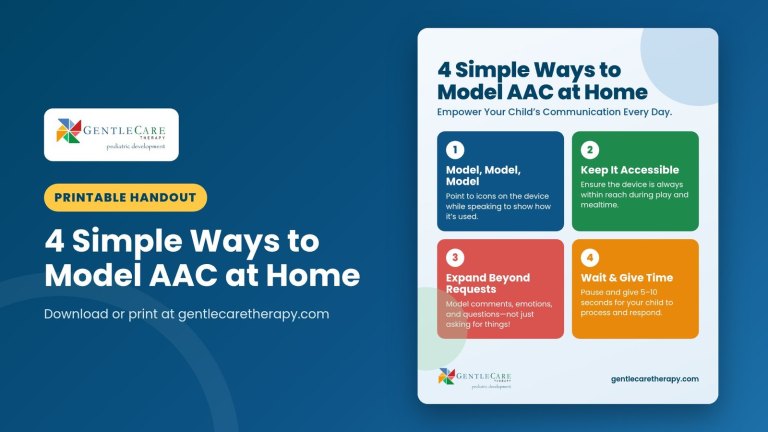
- Handout: 4 Simple Ways to Model AAC at Home
Wondering how to grow your child’s communication? GentleCare Therapy provides ABA therapy in Gibbsboro, NJ and across South Jersey. Reach out to talk with our team.