Encourage and Cultivate Positive Behavior in Children
Why Modeling Works
Children learn by watching the people around them, especially their parents and caregivers. When you model a skill, like asking for a turn or saying sorry, your child sees exactly what to do in a real moment. It’s one of the most natural, low-pressure ways to teach social skills, and you can do it all day long. Here are four simple ways to start.
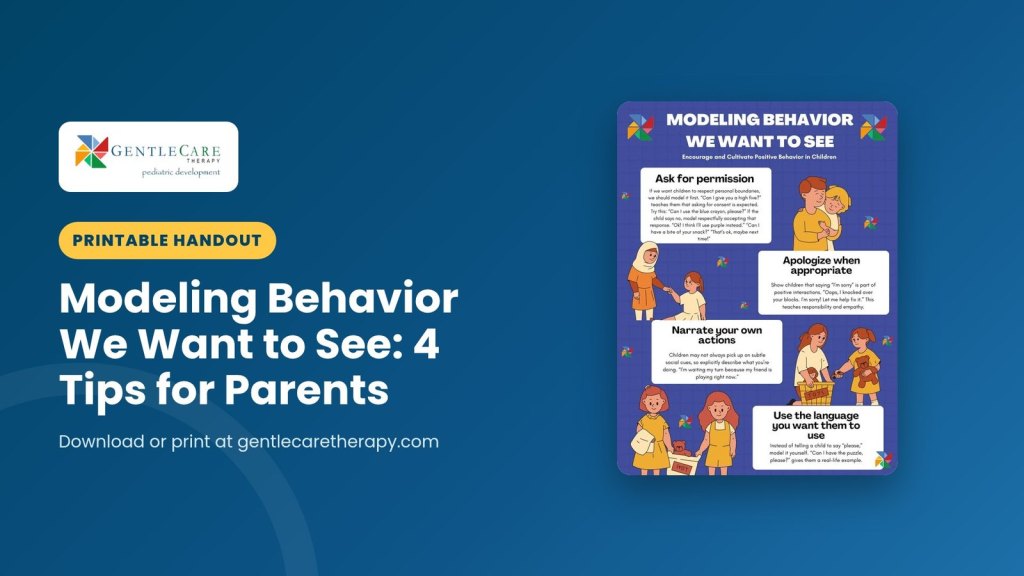
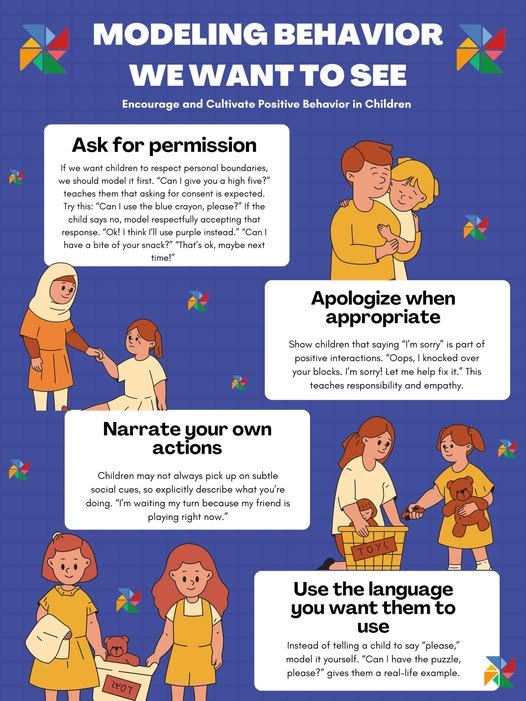
Ask for Permission
If we want children to respect personal boundaries, we should model it first. “Can I give you a high five?” teaches them that asking for consent is expected. Try this: “Can I use the blue crayon, please?” If the child says no, model respectfully accepting that response. “Ok! I think I’ll use purple instead.” “Can I have a bite of your snack?” “That’s ok, maybe next time!”
Apologize When Appropriate
Show children that saying “I’m sorry” is part of positive interactions. “Oops, I knocked over your blocks. I’m sorry! Let me help fix it.” This teaches responsibility and empathy.
Narrate Your Own Actions
Children may not always pick up on subtle social cues, so explicitly describe what you’re doing. “I’m waiting my turn because my friend is playing right now.”
Use the Language You Want Them to Use
Instead of telling a child to say “please,” model it yourself. “Can I have the puzzle, please?” gives them a real-life example.
Putting It Together
Try all four tips in one routine. At snack time: “Can I have a cracker, please?” If your child says no, smile and say, “Okay, maybe next time!” At play time: “I’m waiting for my turn with the cars because you’re playing right now.” And if you bump their tower: “Oops, I’m sorry! Let me help fix it.”
How GentleCare Applies It
Modeling is one of the teaching techniques our ABA therapists use every day, along with prompting and reinforcement. In caregiver training, your child’s BCBA can model programs and demonstrate techniques, then offer feedback and coaching as you practice, so the same skills carry over to home.
Frequently Asked Questions
What is modeling in ABA therapy?
Modeling means showing a child the behavior you want them to learn so they can see it and imitate it.
How can I teach my child to ask for permission?
Ask permission yourself in everyday moments, and accept “no” calmly so your child sees both sides.
Does GentleCare offer parent training?
Yes. Caregiver training is led by your child’s BCBA and tailored to your family. Learn about parent/caregiver training.
Helpful links:
- Our ABA therapy services
- What Is Parent/Caregiver Training?
- Parent workshops
- Handout: 7 Ideas for De-Escalating
- Blog: Modeling the Behavior You Want to See
Want more support building positive behavior at home? GentleCare Therapy offers ABA therapy and caregiver training in Gibbsboro and throughout Camden County. Contact us to get started.